🕍 The Basílica de la Virgen de los Desamparados in Valencia
📍 Location and Significance
The Basilica of Our Lady of the Forsaken is located in the heart of Valencia, in the Plaza de la Virgen, next to the Cathedral and the Generalitat Palace. It is dedicated to the Mare de Déu dels Desemparats, the patroness of the city and of the entire Valencian Community, deeply venerated by the people of Valencia.
This temple is one of the most visited devotional sites in the city and, together with the Cathedral and the square itself, constitutes a key point at the religious, cultural, and touristic levels.
🏛️ History
-
15th Century: Devotion to Our Lady of the Forsaken began in the 15th century, when the brotherhood “Nostra Dona dels Innocents e Desamparats” was founded in Valencia to shelter and provide burial for the sick, orphans, and marginalized people.
-
17th Century: Growing devotion to the Virgin led to the construction of a temple in her honor. The first stone of the basilica was laid in 1652, and construction was completed in 1667. It was the first Baroque temple erected in Valencia.
-
Subsequent Centuries: Over the years, the basilica underwent restorations, decorative enhancements, and expansions. In the 20th century, it became the epicenter of Marian devotion in Valencia.
🎨 Architecture and Style
The basilica is an outstanding example of Valencian Baroque, with a very unique structure:
-
Elliptical Plan: Breaks from traditional rectangular layouts and creates a harmonious visual effect.
-
Offset Dome: Not located at the center of the building but misaligned with the main axis, one of its architectural peculiarities.
-
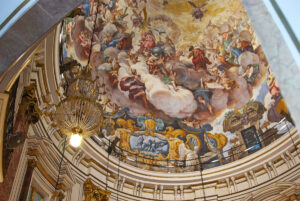
Interior: Notable for its Baroque ornamentation, including frescoes, gilded stuccos, and dynamic design elements.
The complex is connected to the Valencia Cathedral via an arch crossing the street, creating a unique religious space in the city.
🙏 Image of Our Lady of the Forsaken
The most venerated treasure of the basilica is the image of the Mare de Déu dels Desemparats:
-
Authorship: Sculpted in the 15th century, attributed to Pere Moragues, though some studies suggest the involvement of other artists.
-
Characteristics: A polychrome wooden statue in late Gothic style. The Virgin is depicted leaning forward, as if approaching the people. This distinctive inclination earned her the popular nickname “Geperudeta” (the “Little Hunchback”).
-
Crown and Vestments: The image is dressed with richly embroidered mantles and wears a royal crown.
-
Symbolism: Represents the protection of the forsaken, orphans, and those in need, the reason for her deep popular devotion.
🎉 Festivals and Celebrations
The basilica is the focal point of Valencia’s main Marian festivities:
-
Second Sunday of May: Major celebration in honor of Our Lady of the Forsaken, including solemn masses, bell concerts, the emotional “Misa de Descoberta” at dawn, the general procession, and the massive “Traslado” of the image through Plaza de la Virgen.
-
Fallas (March): The Virgin is also central to the Offering of Flowers, where thousands of falleras and falleros present bouquets forming a giant floral mantle in her honor.
-
Religious Acts Throughout the Year: Include rosaries, novenas, and special celebrations on significant dates.
🖼️ Art and Heritage
Highlights of the basilica include:
-
Palomino Frescoes: Antonio Palomino, court painter of Charles II, decorated the dome with spectacular frescoes between 1701 and 1702, representing the glorification of the Virgin.
-
Main Chapel: Houses the camarín of the Virgin, where the original image is kept.
-
Altarpieces and Sculptures: The temple contains Baroque and Neoclassical works, as well as ornamental elements of great historical and artistic value.
👥 Cultural and Religious Role
The Basilica of Our Lady of the Forsaken plays a central role in Valencian life:
-
Religious: One of Spain’s main centers of Marian pilgrimage and an active place of worship.
-
Cultural: Its artistic and architectural heritage attracts thousands of national and international visitors.
-
Identity: Our Lady of the Forsaken is a symbol of unity and identity for the Valencian people, representing tradition, faith, and popular roots.
The Basilica of Valencia is not only a religious temple but also a spiritual, cultural, and heritage symbol of the city. It represents the devotion of the Valencian people to their patroness and the connection between history, art, and faith that defines Valencia.